

Age of AI Agents : Today, AI tools aren’t limited to simply answering questions. In the Age of AI Agents, AI systems are beginning to understand users and remember their preferences. But there’s a problem—if AI remembers everything, what will happen to privacy and data security?
In traditional software, memory was solely for storing data. But for modern AI agents, memory has become a dynamic system that helps them understand context, conversations, and user behavior.
In this article, we’ll explain in simple terms the architecture of AI agent memory, how short-term and long-term memory systems work, and how AI agents might collaborate with humans in the future.

Traditional AI vs AI Agents
| Traditional AI | AI Agents |
|---|---|
| Conversation close hone par sab bhool jata hai | Past interaction yaad rakh sakta hai |
| Naye facts ke liye retraining zaroori | Database update se knowledge improve |
| Sirf prompt par kaam karta hai | Goals aur tasks follow kar sakta hai |
| Static system | Adaptive system |
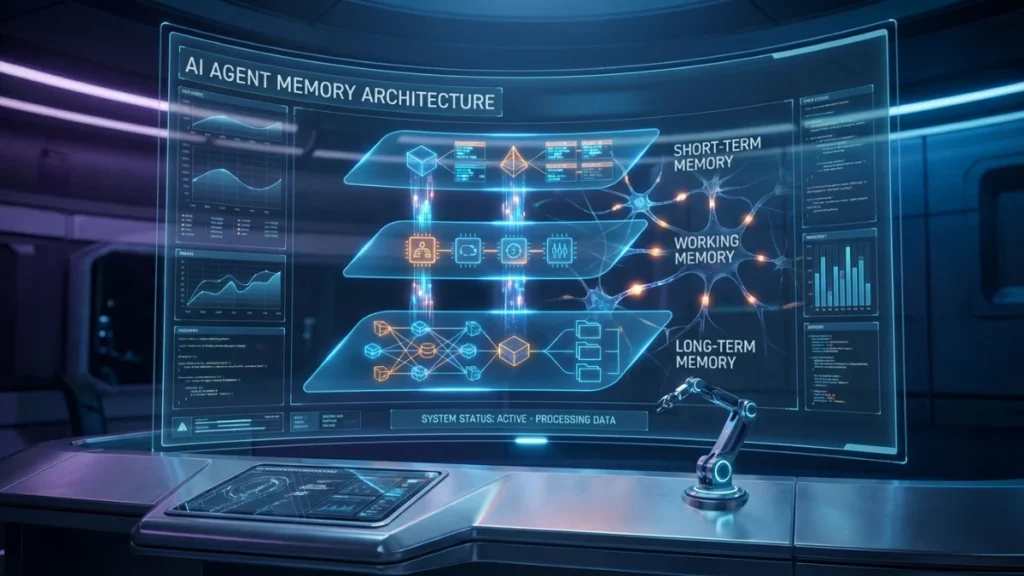
AI Agent Memory Architecture
Memory system of AI agents is based on three main layers, which help the AI manage conversations and knowledge.
- Short-Term Memory (Context Window)
This is the AI’s temporary memory where the current conversation is stored. User messages and the AI’s replies are stored here. When a chat becomes too long, old messages are automatically removed. - Working Memory (RAG System)
This layer searches and uses external data. The AI analyzes the question, finds relevant information in the database, and generates an answer based on that data. - Long-Term Memory (Persistent Memory)
This is the AI’s permanent memory where user preferences, past interactions, and knowledge can be stored. This includes semantic memory (general knowledge) and episodic memory (past experiences).
This system could make future AI assistants more personalized and smarter.
What is Age of AI Agents?
Age of AI Agents refers to a new phase in artificial intelligence where AI systems move beyond simple tools or chatbots and become autonomous digital assistants that can plan, decide, remember, and take actions on behalf of humans.
Earlier AI systems mostly worked like question-answer machines. You asked something, and the system responded. But in the Age of AI Agents, AI systems are designed to act more like collaborators or digital workers rather than passive tools.
Read this also
Why AI is growing in AI agents?
- AI agents are becoming personalized digital assistants.
- Businesses are adopting AI agents for automation.
- Vector databases and knowledge graphs are improving AI memory.
- Agent frameworks have become easier for developers.
- Demand for AI productivity tools is rapidly increasing.
- Research and investment in AI agents is increasing.
- Enterprise companies are adopting AI workflows.
⬇️Join PublicHub24 For Latest Update 📲
Daily Local News & Trending News
| Join WhatsApp Channel | Join Now |
| LinkedIn Profile | Connect Now |
| YouTube Channel | Subscribe Now |
Disclaimer: Please verify before use or purchasing this tool, all features, pricing, and policies on the official website, Terms are subject to change over time.
FAQs
- Memory in the Age of AI Agents
Iska matlab hai AI systems me advanced memory architecture jisme short-term, working aur long-term memory layers hoti hain.
- Microsoft building AI agents course
Microsoft aur kai tech companies developers ke liye courses launch kar rahe hain jisme AI agent development aur tools sikhaye jate hain.
- Microsoft build AI agent
Developers Azure AI tools aur frameworks use karke AI agents create kar sakte hain jo automation aur decision making me help karte hain.
- AI agent memory
AI agent memory ek system hota hai jo conversations, knowledge aur user preferences ko store aur retrieve karta hai.
CONCLUSION
The Age of AI Agents represents a new phase in technology where AI is moving toward becoming collaborative assistants, not just tools.
The most important part of this transformation is AI memory architecture. When AI systems combine short-term context, external knowledge, and long-term preferences, they become more useful and intelligent for users.
But it’s also important to focus on privacy, data security, and ethical AI development.
If you’re a student, developer, or technology enthusiast, understanding AI agents and agentic systems can be crucial for future career and technology trends.
In the coming years, AI agents will likely become a normal part of our digital workflows.
